
UX Design Process
Infographic
Audience: UX Designers, Stakeholders, Project Managers
Responsibilities: Develop an infographic explaining the UX Design Process
Problem Solved: Communicate the Design Process in a Succinct infographic.
Strategies: Information Chunking, Visual Hierarchy and Flow, Spatial Contiguity, Descriptive text with representative icons, Data Visualization
Tool: Adobe Photoshop
Timeline: Aug-Sept 2025
Project Overview
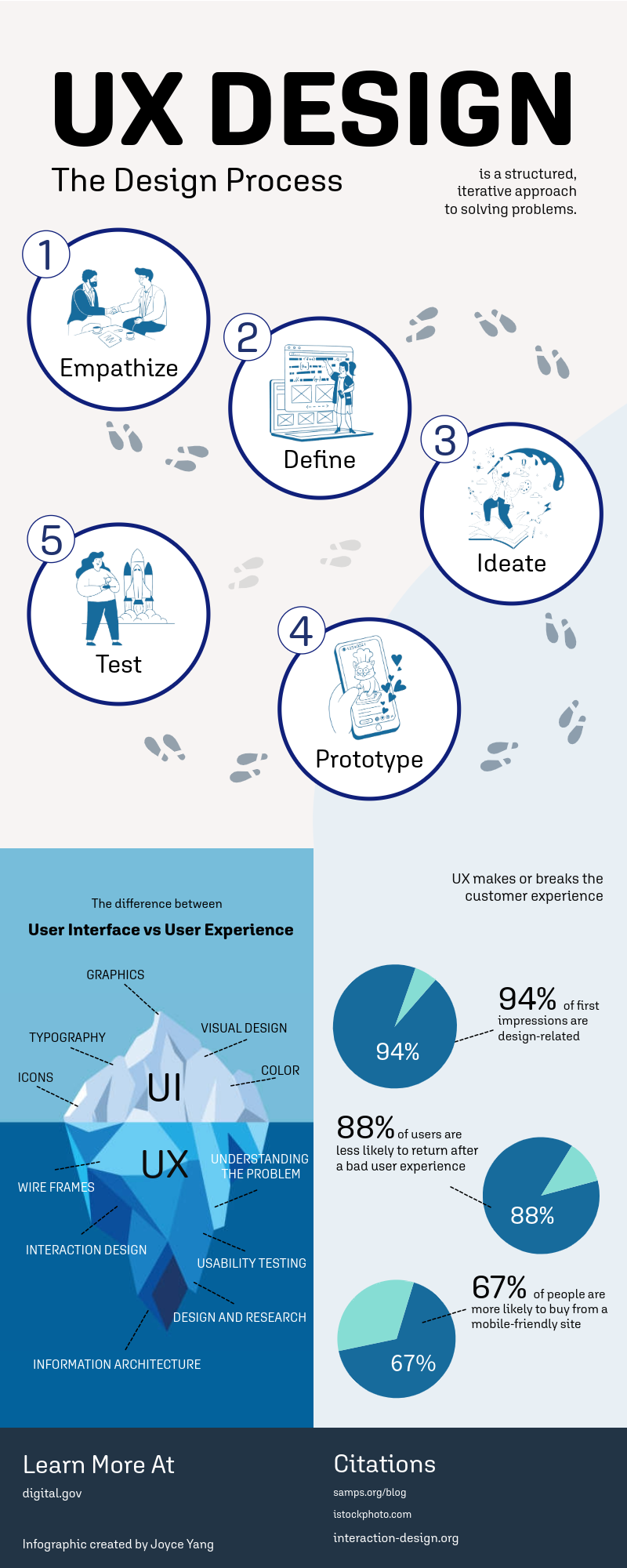
This infographic was created as an educational tool to demystify the UX design process for stakeholders and non-designers. The primary goal is to provide a structured, high-level overview of the iterative nature of design thinking while highlighting the critical business value of user experience.
Design Process
The infographic outlines a 5-step iterative roadmap, using a clear visual trail to guide the learner through the lifecycle of a project.
A key instructional strategy used in this project is the Iceberg Metaphor. This mental model helps learners distinguish between the visible and invisible layers of design:
UI (Surface Layer): Focuses on the aesthetic elements such as graphics, typography, icons, and color palettes.
UX (Foundational Layer): Focuses on the structural and analytical work beneath the surface, including information architecture, usability testing, and deep problem understanding.
To ensure maximum retention and clarity, I applied several cognitive learning principles:
Signaling & Sequencing: Numbered steps and footprint directional cues create a clear narrative flow.
Data Visualization: Converting complex industry statistics into digestible pie charts to emphasize the high stakes of "design-related first impressions" (94%) and "user retention" (88%).
Spatial Contiguity: Placing citations and supplementary information at the bottom (footer) to keep the primary learning area focused and clutter-free.
Accessibility: Prioritized high-contrast text and clear font hierarchies to ensure the information is accessible to a wide audience.
Takeaway
Designing with an accessibility-first mindset proved to be the most critical "hidden" layer of the UX process for this project. By prioritizing high-contrast text and clear font hierarchies, I reinforced the first step of the design thinking process: Empathy. This project confirmed that inclusive design is not just about meeting standards; it is about reducing cognitive load for all learners. When information is structured to be accessible to the widest possible audience, the clarity of the instructional message is maximized for everyone.